The animal first
Every decision starts with the question: what does this cat need? Everything else follows from that.
Margo’s work already exists. The initiative helps to organise care, treatment, documentation and responsibility so that they become sustainable in the long term.
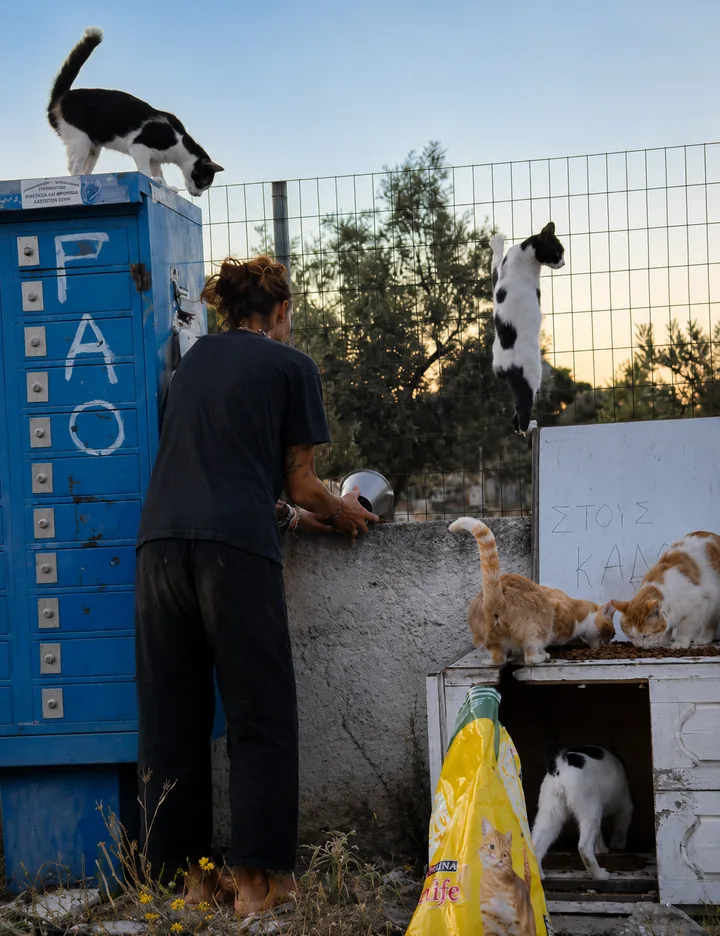
In Artemida near Athens, Margo began caring for street cats many years ago. A few animals became dozens. The responsibility grew with every year – and Margo stayed.
There were turning points. She ran a beach café; a fire destroyed it. What remained were the animals and the decision to carry on, even when it became harder than ever before.
Today she drives her rounds daily, feeds, treats and arranges veterinary visits – much of it out of her own pocket. During the day she works as a surf instructor at her sister’s windsurfing school, on whose grounds some of the cats live. Work and care merge into one another there. By her own estimate she has looked after well over three hundred cats over the years – some rehomed, many staying.
The first cats have already been rehomed to Germany together with the partner association. Yet almost everything still depends on one single person. This is exactly where the initiative comes in: organising knowledge, disclosing costs, building rehoming routes and spreading the load across more shoulders.
In her own words. Margo told her story herself — unedited, in a single continuous video of around thirteen minutes. The timeline below summarises the stages; the video will be added here.
A single continuous video, deliberately unedited. The timeline on the right walks through the stages — from the first animals to everyday life today.
Margo’s video will be embedded here — data-minimising, via a two-click player. A connection to the provider is only made when you press play. Duration approx. 13 minutes.
„I always had cats and dogs, my whole life. My sister and I, we always liked all animals, nature, everything. We always wanted to be there for them.“
„Near us we had a very big wildfire, for four days. My sister and I went as volunteers to rescue animals — in the fire, or whatever was left the next day. It was a nightmare.“
„Afterwards everything was grey, dead — you heard nothing at all. Since then I have put out food and water on different streets every day and never stopped, not once. Again and again I found injured cats, took them in and brought them to the vet.“
„I try to rehome the cats I have here, so they find a real home. When you have too many animals, you are no longer there one hundred percent for each one. I give them as much love as I can — they feel it, they hear me from far away when I come with the car.“
„I had my own business, a beach bar. About four years ago it burned down — in one and a half hours everything was gone. After that it started to get really hard, with all the feeding and all the animals.“
„In the end I am very tired and sometimes I ask myself: when will there be an end? But when I sit on the sofa and my little cats come and lie down against me, then I think: thank God I am here for them. I have found good people who help me.“
„Recently a cat was run over, and nobody went to pick her up. I stopped and took her in my arms, even though she was already dead. I wish people would open their hearts — look whether an animal needs help. They cannot speak. I think I am here for them because they cannot speak.“
„Now you have got to know me — I have said what I feel. I am so grateful. Whatever you do for me and my animals: what comes around, goes around.“
Five areas of care, numerous animals – that is the structure behind the daily work.

Every decision starts with the question: what does this cat need? Everything else follows from that.
Animal welfare is decided in everyday life: feeding, treating, documenting – every day, even when nobody is watching.
Honest profiles, vetted families, personal approval by Margo, follow-up included. A home only becomes a home when it lasts.
We work closely with vets and experienced partner organisations – and document every health step traceably.
Costs, donations, decisions: everything is recorded and traceable. Trust is not created by words but by insight.
A one-woman effort becomes a community: sponsors, foster homes, translators, drivers, associations – many shoulders instead of one.
Safety instead of the street
Health instead of chance
Neutering instead of endless breeding
A home instead of uncertainty
Less explaining, more impact
Information finally has a place
Tasks become shareable
Time and energy belong to the animals again
Honest profiles instead of surprises
Support before and after adoption
A cat whose story you know
Every euro traceable
A direct line instead of an anonymous donation pot
Impact you can see – cat by cat
Every neutering prevents future suffering, every rehoming makes room for the next emergency – and every documented decision shows that individual animal welfare can become a system that lasts. A model worth following.
Five systems of relief are taking shape under the roof of the initiative. A worked-out concept exists for each – here we show openly what each system achieves and how far along we are.
Margo no longer has to repeat herself constantly.
A central knowledge base for animals, costs, partners and processes – every piece of information gets a fixed place instead of sitting in chats and memories.
Fewer cats in her care.
A clear pipeline from intake to follow-up – starting with the 20 cats whose rehoming brings relief fastest.
Less operational dependence on Margo.
Clear roles, decision rules and a fixed weekly rhythm spread responsibility across many shoulders – without it disappearing.
Less financial pressure.
Cost clarity, sponsorships, partners and transparency reports make support predictable – the key metric: Margo’s private share goes down.
More people understand and support the initiative.
This website is its first building block. Progress, success stories and short monthly reports will appear here – honest, regular, traceable.
What we are working on in the first 30 days:
As of July 2026 · progress and monthly reports will be published here.
We work in stages and state openly what has not yet been decided. Funders can support a specific stage.
Only if the preconditions are met:
A permanent place for care, quarantine and recovery would be the greatest relief in the long term. We expressly do not present it here as a decided construction project. Before it can become a fundable undertaking, the following points must be clarified:
As long as these preconditions are open, there are no fundraising appeals and no project card for it. Progress in the review will be documented here.